Bouncing back from failure
A 2000 mile journey that should be impossible

I will often ask athletes or performers I work with who they look up to. There are a number of reasons for this. Firstly, we can get vicarious confidence from seeing other people quite like ourselves doing things well. We feel if they can manage it maybe we are safe to try too. Secondly we can learn from others approaches and mindsets. It is why when I wrote The 10 Pillars of Success I really wanted a ‘success story’ in each chapter. Someone who brings each pillar to life.
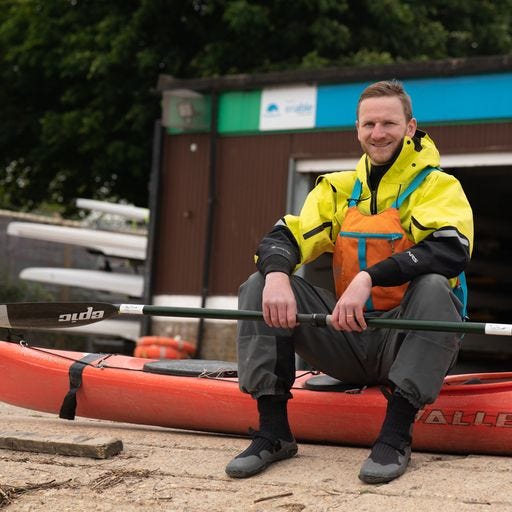
This week I heard of someone I really wanted to learn from and to be able to share his perspectives; Mark Agnew. He is a 32 year old adventurer who is aiming (along with three others – who he hasn’t yet met!) to be the first to kayak the Arctic’s 2000-mile Northwest Passage. They set off in a few days’ time, on July 1st from Bylot Island in Canada and hope to finish around 90 days later at Tuktoyaktuk, an Inuit hamlet in Canada. They will follow the historic Arctic route that links the Atlantic and the Pacific. This will be the first time the entire route has ever been kayaked. It will also be the first time it is completed with just human power alone in any type of craft in a single summer.
As well as the physical discomfort that Mark and his teammates will need to endure there are real physical risks too – not just harsh elements of the Arctic but also polar bears who may want to investigate them when they camp onshore each night.
What interests me in Mark’s story is that this isn’t the first time he has attempted an incredibly difficult challenge. In 2016 and again in 2018 Mark attempted to set the world record for rowing across the Atlantic but failed both times. This, of course, left him struggling mentally trying to handle that setback. He found some solace in a the work of Carless & Douglas who focus on narratives and the stories that elite athletes tell themselves. “It is not supposed to be self-help it is just framework why some people take in sport but it really spoke to me. For me my adventures are about performance, discovery and relationships.”
Here are his thoughts about the challenge ahead and the mental approach he plans to take…
Creating your own narrative
“I tried to row the Atlantic twice and on each occasion I said I was going to set the world record and I failed twice and I felt devastated. I completely spiralled. I wasn’t mentally ill but was completely overwhelmed by the feeling of failure for a very long time. I felt like I had lost a part of myself. Performance, discovery and relationships spoke to me because I had become so focused on the performance aspect in wanting to set the world record I had forgotten about everything else. What I really care about is experience and relationships. For me I see that performance is an extrinsic motivator whereas the other two are intrinsic – these are things I really care about so I am able to judge success on my own terms.”
“Understanding this idea of Narratives has made all of these adventures so much more fulfilling because it comes from the perspective that ‘I want the journey.’ I don’t want the destination or the praise. Going for performance is still important because it facilitates the others too (discovery and relationships) and if you didn’t have a goal you wouldn’t get the camaraderie (the relationships) through shared effort, and if you didn’t have a goal then you would just be like why don’t we camp an extra day and it wouldn’t feel so immersive (the discovery).”
Relationships (and how you cope with three other people in a tiny boat)
“I believe that purpose facilitates camaraderie and this extends beyond a normal relationship. Camaraderie by definition comes through shared struggle which makes it easier to handle the tough parts and the tough parts of your personal relationships because if your aim is to have camaraderie where you will see people at their worst and you will be vulnerable when you are at your worst. This is part of what I am looking for, rather than viewing any friction as an obstacle. If there was no friction, no difficult parts, and I never felt sad or needed support then there would be no camaraderie.”
“I take absolutely nothing personally. When people are annoyed and shouting I know they are just annoyed in general and it is being projected at you so I find it very easy to let things go and I have a very long fuse. I suppose I have a long fuse and a big bomb and when my fuse does run out I tend to snap big time but it only takes me half an hour to calm down and I am very ready to apologise again. I am happy to let bygones be bygones.”
Resilience
“In the wake of the second Atlantic failure I thought I was supposed to be resilient and then I looked into it and realised it can be learnt, it can be trained, so I set out to work on it, And I am doing many of the same things I was doing before anyway but I guess resilience training is just a matter of perspective. If a knee pain on an ultra marathon is an obstacle but if you were doing that ultra marathon to train resilience then you say this is my chance to prove to myself that I am resilient. This is my chance to build up a bank of memories that I can draw upon next time.”
Luck
“The nature of luck is that it only ever meets you half-way. People think luck is random. It is not random in the sense that it treats those who go out of their comfort zone well and you always find opportunities to go for it. The random aspect is that you never know what the opportunity is. I might be lucky with the weather and obviously the opportunity is achieving the north west passage but I might be seen being interviewed and I might get a role on Blue Peter!”
Keeping going on the toughest days
“I have a belief in myself that I thrive when it gets hard. I tell myself I may be a slower kayaker but when there is a headwind I keep going longer than everybody else. Whether or not that is true is immaterial because the fact that I have told myself that means that when it does get hard I say ‘well here we go – this is where I go’ and it becomes a self-fulfilling prophecy. So to stay positive I have spun these stories around myself. And on the days where I do struggle I will tell myself well you can’t be good every day and try to be kind to myself.”
“I will also go back to those intrinsic values – on the days where it is so so tough and I am not going anywhere because the conditions are terrible I will remind myself that I wanted to be immersed in nature, I wanted to feel it viscerally and all of its power and variations so when the storms come or the waves break is this what I wanted. And from that perspective you are getting something out of even the worse days.”
Mark is taking on this challenge in aid of Wilderness Foundation.
He can be followed at: https://www.thearcticcowboys.com and @adventureagnew on Twitter and Instagram
.