Pointless words upon a wall...
Why we need to focus on our own values - not those of an organisation.

One of my favourite sessions to do with clients is to help them identify their values. Reflecting on, and talking about the things that matter to us, really matter to us, can be really invigorating.
Values are:
· Shaped by our personality, our history and the things we experience.
· Ongoing rather than an end point.
· Not things that get achieved
· They are compass points not destinations
· Ways of acting rather than actions.
· Not right or wrong. Values are an end in themselves
· Focused on fulfilment rather than happiness.
Our values really drive who we are at our deepest level. If we are able to become more aware and start living by them then we will feel much more in control of everything going on around us. What I love about having heightened awareness of your values is that even when life goes squiff (and if you watch the news it does seem rather squiff at the moment) and our goals seem unobtainable for a while we can still choose to live by our values – they give us flexibility and increased autonomy.
What always makes me chuckle is when companies talk about their values. I see those individuals I work with really dig deep to think about their values, what truly matters to them. And when we have identified them we stress test them: What Value Based Actions can you do this week? Who is likely to violate one of those values? How can we protect you from that?
Can a company do this? Values come from the heart and that means they bring emotion to the table. Has anyone got emotional about a company value?
Worse still is that having these company values means we have to subsume our own. How can we work authentically, with any passion or purpose if we are having to subsume our personal values to follow company ones?
I went to see Steve Cummings (former Pro Cyclist and now Director Sportive for Ineos Grenadiers) at a talk last night. He gave a number of examples when different teams had tried to be so prescriptive with the ways they expected the cyclists to work that it actually became far harder to do well. In one team he said there were so many rules that ahead of each Tour De France stage there would be a full 40-minute PowerPoint presentation which added intensity and fatigue. “It was over prescriptive and too much to remember.” In another team he recalled them “Trying to control me like a Playstation.” When he was given the freedom to follow his own values, he performed far better and started to win stages.
If we can give each other the autonomy to follow our own values performance will rise. And as there are no bad values this should feel fairly safe. This means for each of us when our values and actions line up you can put so much more passion into your performance, in whatever arena. Far more than you can if the values you are aiming to follow belong to someone (or something) else.
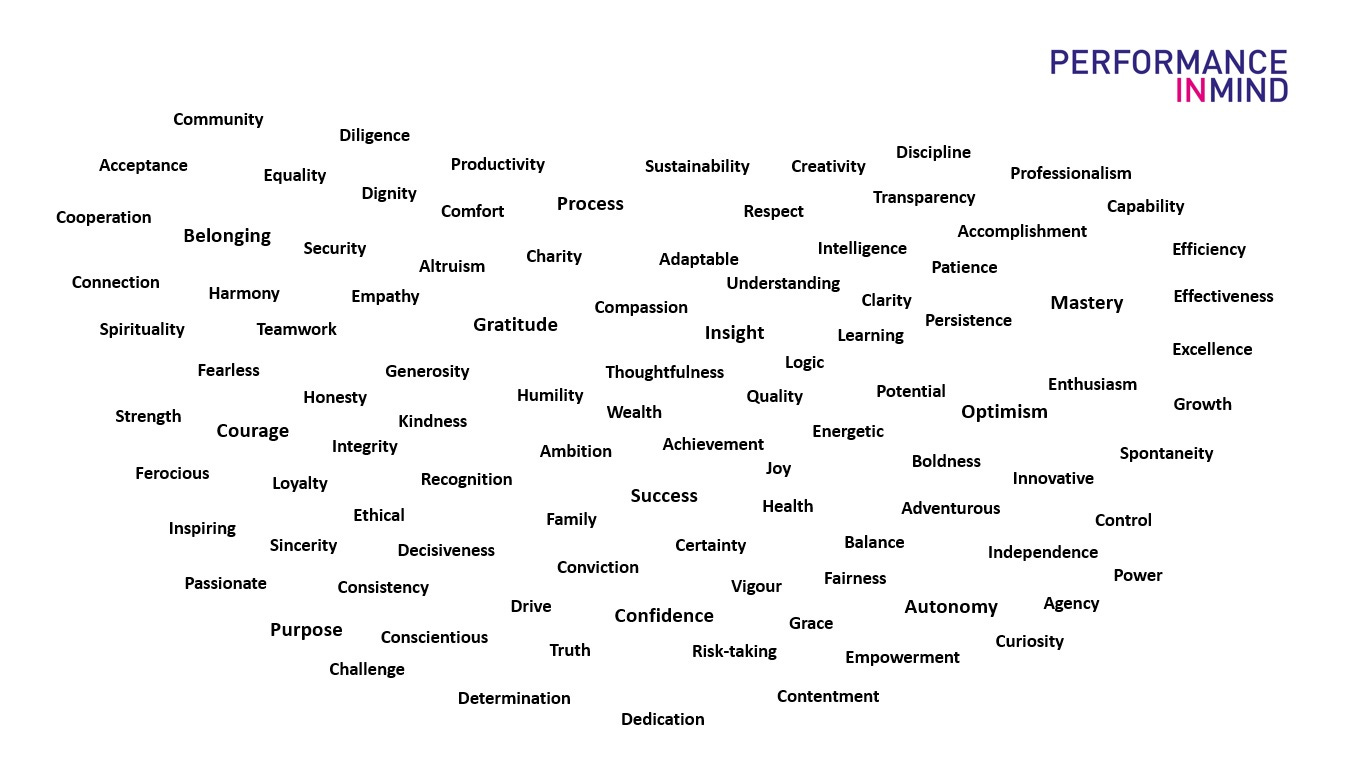
Below there is a sheet of 100 different values. Consider what each means to you. Cross off all those which you don’t immediately go ‘Yes – that is me.’ It should be easy to cross off about 50 of them. Then it gets much harder. Ideally, we would like you to get down to three values. These will be your core values.
A life well lived is a life lived according to your values
Cycling Psychology
On a cycling theme - great pieces of psychological advice that everyday riders have taken from pro cyclists or writers in their autobiographies were shared yesterday on my twitter feed – thanks to all who contributed. Here are ten great ones. What resonates for you that you could incorporate into our own sporting endeavours?
· Charlie Wegeluis - Never wonder if you had more to give – always 100% effort on the start line.
· Brad Wiggins – Break your effort down into psychologically manageable chunks (in sports psych we call this chunking).
· Chris Froome – Learn to love the pain of training.
· Ian Walker – Things don’t tend to keep getting worse.
· Steven Burke – Let the pain come to you.
· Amber Pierce – Give yourself permission to make mistakes.
· Greg LeMond – It doesn’t get any easier – you just get faster.
· Paul Jones – If I wasn’t riding right now I wouldn’t have seen that or been here.
· Chris Boardman – Can I hold this to the end? If the answer is yes you’re too slow. If the answer is no then you are too fast. The answer needs to be maybe.
· Chris Hoy – You need to commit to it.